
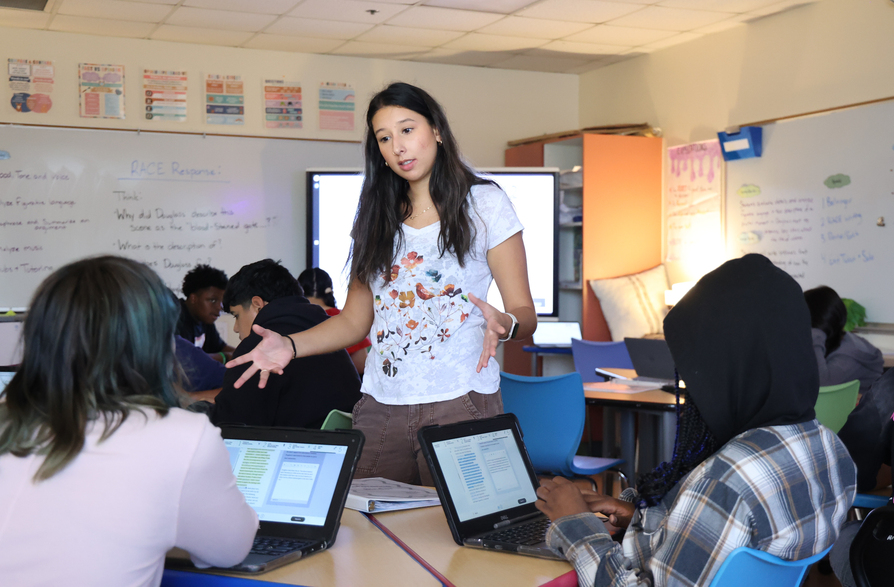
Six weeks into the fall semester, Justin Watwood has seen a lot of change at Poe Middle School on his third year on the campus.
As principal of one of three schools in the district operating as resource campuses in the state’s Accelerating Campus Excellence (ACE) initiative, Watwood is watching what happens when 70 percent of the school’s core teachers hold a Teacher Incentive Allotment designation from the Texas Education Agency, and the rest are well on their way.
The ACE model, which operates on the belief that the most skilled teachers should be matched with the students who face the greatest challenges, has already seen preliminary success in Texas and is now being offered at Poe, Hot Wells Middle School, and Crockett Academy. The model incentivizes designated teachers with an additional strategic stipend on top of their Teacher Incentive allotment, to compensate for additional office hours during the school week and 11 additional teaching days per year. All faculty receive intensive, data-driven coaching and daily planning blocks.
At Poe, teachers stay until 5:30 p.m. twice a week. The time is used for tutoring and evaluating and planning during weekly Professional Learning Communities (PLCs).
“One of the things I was looking forward to is the ability to have additional time on campus where we can actually organize things, set up lessons properly, and adjust and monitor instruction to best fit the needs of our students,” said Riley Cotham, who teaches seventh grade social studies. “Just having more time in general is something that every single teacher needs, and the extra time we do get is helpful.”
In PLCs, teachers gather and look at a specific skill they’ve taught in a previous week to evaluate, articulate what different levels of student success looks like, and gain ideas for reteaching. It also provides a time for teachers to plan cross-curricular connections and needs.
“There is an immediate link between social studies and reading and science and math,” Cotham added. “There's a noticeable difference in social studies. When we have students that aren’t achieving academically in reading, that follows through the social studies. I have some students who are not reading with great comprehension right now. So when our scores in reading go up, our scores in social studies will also go up.”
At Poe, the scores are tracked in the Data Room. On the third floor of the campus, behind a door labeled “Data or it didn’t happen,” the school tracks data for every student in the school, grouped by grade level and achievement level in core areas. Teachers can visually see how their students are moving in each of the core areas, and also as the waves of students move from left to right across the board from STAAR projections of did not meet, to approaching, meets and masters.
With a unified and very visual goal, new and returning teachers at Poe are also enjoying unified systems and procedures.
Social studies department chair Villanka Stroud, who has been at Poe for four years, said a major benefit of having so many highly qualified educators in one space is that it is easy to implement systems campus-wide.
“It's good because all the teachers are either master teachers or about to be a master teacher,” Stroud said. “With all of the kids going through classrooms that have systems in place, they're starting to get used to it. If it's done in this classroom, then it's going to follow through to other classrooms. It’s lot of people, with a lot of systems, that keep the machine going.”
Watwood said it has made a difference in the number of behavior incidents this year.
“You’re not having as many admin calls to classrooms because teachers have those routines and procedures in their rooms,” Watwood said. “So, you're not having as many behavior incidents inside the classroom either, which also promotes learning.”
One of the main differences with the ACE model this year that students and parents are now seeing is the additional instructional days, 11 total, with most of them occurring on days when many other district schools are having professional development time. The first of which is Friday, Sept. 18.
During these days, teachers can provide targeted enrichment and interventions to students as needed.
“We’re able to pull out smaller groups to target what they're struggling and give them that extra help that they need,” said Yesenia Montalvo, who teaches eighth grade science.
The campus is also introducing more than 15 clubs for enrichment, including creative writing, Esports, pickleball, crafts and more.
“You want to do something that's fun, so that they can collaborate and make those nice connections with not just teachers, but with other peers that have same interests as them,” Montalvo added.
But with most teachers sponsoring a club, the students will also get a glimpse into their teachers’ personalities.
“It will be really nice for the kids, as well as the teachers,” said Crystal Rocha, who is new to Poe and teaching seventh grade science. “It allows us to bond with them on a social level, not just academic.”
With many changes at Poe, Watwood said he’s excited for the school’s upward trajectory, as the school has raised its accountability score 10 points last year, and is on the precipice of a C. And the biggest change, he said, is the confidence students are building in themselves.
“The biggest thing is the way that students are talking about their academics and about how they're doing on the tests and how they're growing,” Watwood said. “They're just much more bought in because that's the culture of all the classrooms in the school and all the teachers. It's early in the year, and it's going to keep getting even better.”
El modelo ACE acelera el crecimiento en tres escuelas
Seis semanas después del semestre de otoño, Justin Watwood ha sido testigo de muchos cambios en Poe Middle School, en su tercer año en el campus.
Como director de una de las tres escuelas en el distrito que operan como centros de recursos en la iniciativa estatal Impulsando la Excelencia en el Campus (ACE, por sus siglas en inglés), Watwood está observando lo que sucede cuando el 70 por ciento de los maestros principales de la escuela cuentan con la designación de una retribución como incentivo para maestros de la Agencia de Educación de Texas, y el resto va por buen camino para conseguirla.
El modelo ACE, que opera con la creencia de que los maestros más calificados deben asignarse a los alumnos que enfrentan mayores dificultades, ya ha obtenido resultados preliminares positivos en Texas y ahora se está ofreciendo en Poe, Hot Wells Middle School y Crockett Academy. El modelo ofrece a los maestros designados un estipendio estratégico adicional, además de su designación de la retribución como incentivo para maestros, con el fin de compensar las horas de oficina adicionales durante la semana escolar y los 11 días lectivos adicionales al año. Todos los maestros reciben entrenamiento intensivo, basado en datos y sesiones diarias de planificación.
En Poe, los maestros se quedan hasta las 5:30 p.m. dos veces por semana. Este tiempo se utiliza para ofrecer tutoría, para evaluar y planificar durante las reuniones semanales de las Comunidades de Aprendizaje Profesional (PLC).
«Una de las cosas que más me ilusionaba era poder disponer de más tiempo en la escuela, donde podamos organizar las cosas, preparar las clases como es debido y adaptar y supervisar la enseñanza para que se ajuste lo mejor posible a las necesidades de nuestros alumnos», afirmó Riley Cotham, maestro de Estudios Sociales de séptimo año. «El simple hecho de tener más tiempo en general es algo que cada maestro necesita, y el tiempo extra que obtenemos nos resulta de gran ayuda».
En los PLC, los maestros se reúnen y analizan una habilidad específica que impartieron la semana anterior para evaluarla, definir cómo se ven los diferentes niveles de éxito de los alumnos y obtener ideas para volver a impartirla. También proporciona un tiempo para que los maestros planifiquen conexiones y necesidades interdisciplinares.
«Existe una relación directa entre los estudios sociales, la lectura, las ciencias y las matemáticas», añadió Cotham. «Hay una diferencia notable en los estudios sociales. Cuando tenemos alumnos que no obtienen buenos resultados académicos en lectura, eso se refleja también en las ciencias sociales. Tengo algunos alumnos que, por ahora, no leen con mucha comprensión. Así que, cuando mejoran nuestras calificaciones en lectura, nuestras calificaciones en estudios sociales también mejoran».
En Poe, las calificaciones se registran en la sala de datos. En el tercer piso del campus, tras una puerta con el letrero «Si no hay datos, es como si no hubiera pasado», la escuela registra datos de todos los alumnos, agrupados por grado y nivel de rendimiento en las materias básicas. Los maestros pueden ver visualmente cómo progresan sus alumnos en cada una de las materias básicas, así como el desplazamiento de los grupos de alumnos de izquierda a derecha a lo largo del panel, pasando de las proyecciones del STAAR de «no cumple» a «se acerca», «cumple» y «domina».
Con un objetivo común y muy claro, tanto los maestros nuevos como los que ya formaban parte del equipo de Poe están disfrutando también de unos sistemas y procedimientos unificados.
La presidenta del departamento de estudios sociales, Villanka Stroud, quien ha estado en Poe durante cuatro años, dijo que un beneficio importante de tener tantos educadores altamente calificados en un solo espacio es que es fácil implementar sistemas en todo el campus.
«Es bueno porque todos los maestros son maestros expertos o están a punto de ser maestros expertos», dijo Stroud. «Ahora que todos los niños asisten a clases en las que ya se han implantado estos sistemas, están empezando a acostumbrarse a ellos. Si se hace en esta clase, se extenderá a las demás clases. Son muchas las personas, con muchos sistemas, las que hacen que todo funcione».
Watwood afirmó que esto ha influido en el número de incidentes de conducta que se han producido este año.
«No estás teniendo tantas llamadas administrativas a los salones porque los maestros tienen esas rutinas y procedimientos en sus salones, dijo Watwood. «Así que, tampoco estás teniendo tantos incidentes de conducta dentro del salón, lo que también favorece el aprendizaje».
Una de las principales diferencias con el modelo ACE de este año que los alumnos y los padres están viendo días de instrucción adicionales, 11 en total, la mayoría de los cuales coinciden con días en los que muchas otras escuelas del distrito dedican ese tiempo al desarrollo profesional. El primero de los cuales es el viernes 18 de septiembre.
Durante estos días, los maestros pueden ofrecer a los alumnos actividades de enriquecimiento e intervenciones específicas según sea necesario.
«Podemos formar grupos más reducidos para centrarnos en las dificultades que tienen y ofrecerles esa ayuda adicional que necesitan», afirmó Yesenia Montalvo, maestra de Ciencias de octavo grado.
El campus también está poniendo en marcha más de 15 clubes para el enriquecimiento, incluyendo escritura creativa, deportes electrónicos, pickleball, manualidades y más.
«Quieres hacer algo que sea divertido, para que puedan colaborar y hacer esas buenas conexiones no solo con los maestros, sino con otros compañeros que tienen los mismos intereses que ellos», agregó Montalvo.
Además, con la mayoría de los maestros patrocinando un club, los alumnos también podrán ver las personalidades de sus maestros.
«Será muy agradable para los niños, así como para los maestros», dijo Crystal Rocha, quien es nueva en Poe y enseña Ciencias en séptimo grado. «Nos permite vincularnos con ellos a nivel social, no solo académico».
Con muchos cambios en Poe, Watwood dijo que está emocionado por la trayectoria ascendente de la escuela, ya que la escuela ha aumentado su puntuación de responsabilidad académica 10 puntos desde el año pasado, y está en el precipicio de una C. Y el mayor cambio, dijo, es la confianza que los alumnos están construyendo en sí mismos.
«Lo más importante es la forma en que los estudiantes hablan sobre sus estudios académicos y sobre cómo les va en los exámenes y cómo están creciendo», dijo Watwood. «Simplemente están mucho más comprometidos porque esa es la cultura en todos los salones de la escuela y de todos los maestros. Aún estamos a principios de año, y esto va a seguir mejorando».