
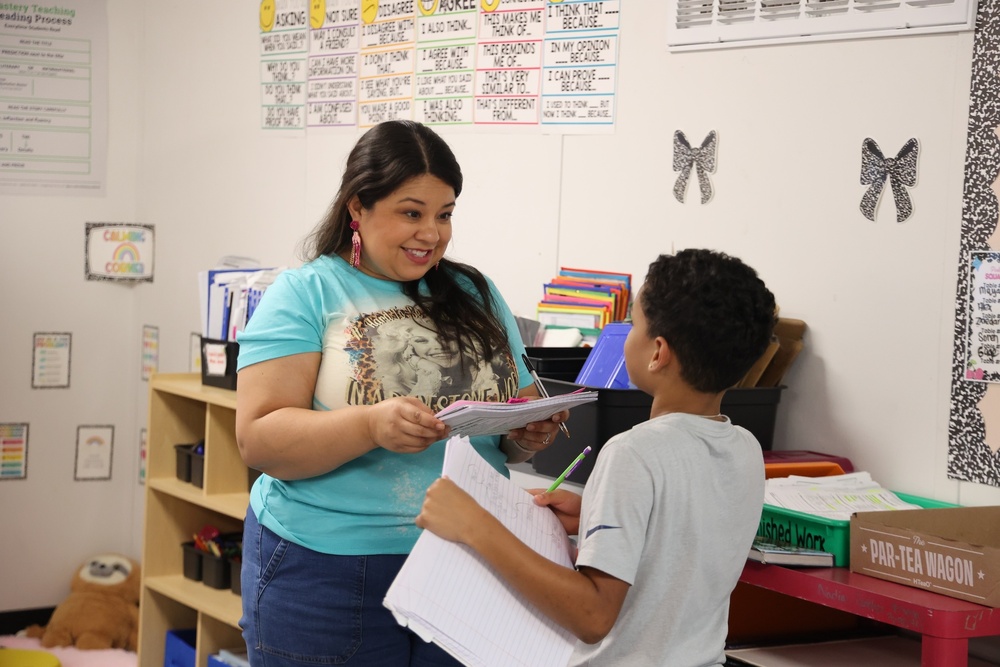
As SAISD rolls out its SAISD High 5 initiative, schools across the district are standardizing five key areas of excellence: classroom board configuration, checks for understanding, structured Professional Learning Community (PLC) sessions, campus data trackers, and the use of strategic walkthroughs for consistent feedback.
Earlier this month, the High 5 initiative was introduced to principals, and the Sept. 18 Professional Development Day focused on preparing teachers for its implementation. Regular campus visits by district leadership are helping reinforce its core principles and support schools during this initial phase. In the coming weeks, principals and teachers will have opportunities to highlight how these standards are being brought to life in classrooms across the district.
As classrooms continue to work toward full implementation, campuses are already reaping rewards as they begin the process of this systemic approach.
At Woodlawn Hills Elementary, principal Tabitha Acevedo says the framework is augmenting procedures the International Baccalaureate campus already had in place.
“I think the implementation so far has been rather successful,” Acevedo said. “We definitely have approached the High 5 as a system, an instructional framework versus separate initiatives. It aligns with our focus this year and has given us more solid direction — it streamlined and simplified it. My teachers were able to see, ‘oh, this isn't different than what we were doing.’”
The system starts with board configuration, including the agenda and objective information shared with students on classroom whiteboards or walls. Teachers at all levels are documenting a week’s worth of learning at a time, with agenda segments including Do Now (Warm-up), I Can (Learning Objective), a Language Objective, and an Exit Ticket for each day.
“I have noticed my students becoming more independent during lessons,” said fifth grade teacher Adrianna Benavides. “They are beginning to use the information displayed in the classroom as a resource instead of always relying on me for the next step, which allows them to take more responsibility for their learning.”
Also built into the framework are standardized checks for understanding. Whether done via structured turn-and-talk sessions with classmates or individual whiteboard responses held up for the instructor to see, students are continuously helping their teachers easily hear or see where they are in knowledge acquisition.
At Woodlawn Hills, though practices were in place, the High 5 framework is allowing teachers new ways to use the tools for monitoring success.
“During checks for understanding, especially when using whiteboards, I have observed students looking at one another’s responses, expanding on their own thinking, and engaging in meaningful conversations through accountable talk,” said fourth grade teacher Nadia Sanchez.
Turn and talks are becoming more structured, with teachers offering sentence stems and roles for each discussion, which ties naturally into the characteristics of the IB learner profile.
“I believe the High 5 fits naturally with who we already are as an IB campus,” said fifth grade teacher Taryn Arevalos. “We want our students to think, communicate, reflect, and take more ownership of their learning. High 5 gives us another way to make those things part of what happens in the classroom every day, instead of them being something separate.”
While the classroom configuration and checks for understanding directly impact classroom students during Tier 1 or grade-level instruction, the High 5 offers plenty behind the scenes to support the student experience.
Campuses are moving toward campus-wide data trackers, which not only keep instruction on track, but help students to visualize their own progress.
“We already had decided as a campus last year, we needed to display classroom data, so the students would know where they were as a class,” Acevedo said. “We want the students to have a protocol to where they can speak to their families and walk them through their data and their goals.”
PLC sessions have become more structured, with teachers gathering weekly to analyze what understanding looks like for different TEKS and brainstorming methods to address the needs of students at different levels of mastery.
“The very structured agenda that we were given included the breakdown by minutes, which just provided the little extra clarity that I needed as an instruction leader so that I could roll it out with fidelity on this campus,” Acevedo said. “We had already developed our agenda and were using what was given to us at our leadership summit. However, I feel like this is just a little bit more detailed, and that was the exact detail I needed. So that's been great.”
None of it can work without the guidance and support of a strong administrative team, spending their time in classrooms and giving ideas and strategies to teachers. Walkthroughs are essential in the High 5, and Acevedo and her team have already conducted more than 100 of them since school started.
“That has been a high focus for my instructional leadership team,” Acevedo said. “We need to be in classrooms. Anything else can be done after school. And we've come up with a really structured system to making sure that we're seeing our teachers every week and every teacher is receiving feedback every week.”
Taking the time to implement the High 5 with fidelity does take a little setup time up front, the Woodlawn Hills team admits, but now that synergies are developing, the work is actually getting less time consuming in some ways.
“Taking the time to embrace High 5 has been a positive experience for both me and our campus,” Arevalo said. “I feel that we are better prepared to provide high-quality instruction, and we are seeing students take greater ownership of their learning. The structure and expectations transfer seamlessly across classrooms, creating consistency for students. Most importantly, it has been exciting and rewarding to watch everything come together and see the positive impact on our students.”
Las escuelas comienzan a poner en práctica el programa «SAISD High 5»
A medida que SAISD lanza su iniciativa «SAISD High 5», las escuelas de todo el distrito están estandarizando cinco áreas fundamentales de excelencia: planificación en el pizarrón del salón, revisiones de entendimiento, sesiones estructuradas de la Comunidad de Aprendizaje Profesional (PLC), registro de los datos del campus, y el uso de recorridos estratégicos para una retroalimentación constante.
A principios de este mes se presentó la iniciativa «High 5» a los directores, y la jornada de desarrollo profesional del 18 de septiembre se centró en preparar a los maestros para su implementación. Las visitas regulares al campus por parte del liderazgo del distrito están ayudando a reforzar sus principios fundamentales y apoyar a las escuelas durante esta fase inicial. En las próximas semanas, los directores y maestros tendrán la oportunidad de mostrar cómo estos estándares se están incorporando en los salones de todo el distrito.
A medida que los salones continúan trabajando hacia la implementación total, los campus ya están cosechando recompensas a medida que comienzan el proceso de este enfoque sistémico.
En la primaria Woodlawn Hills Elementary, la directora Tabitha Acevedo dice que el marco curricular está reforzando los procedimientos que el campus del Bachillerato Internacional ya tenía establecidos.
«Creo que la implementación hasta ahora ha sido bastante exitosa», dijo Acevedo. «Sin duda, hemos abordado el "High 5" como un sistema, un marco de instrucción, en lugar de como iniciativas independientes. Se ajusta a nuestro enfoque de este año y nos ha proporcionado una orientación más clara; lo ha optimizado y simplificado. «Mis maestros dijeron: “vaya, esto no es diferente de lo que ya hacemos”».
El sistema comienza con la planificación en el pizarrón, lo que incluye el orden del día y la información sobre los objetivos que se comparte con los estudiantes en los pizarrones o en las paredes del salón. Los maestros de todos los grados están documentando el aprendizaje de cada semana, con segmentos en la orden del día que incluyen «Hacer Ahora» (preparación), «Yo Puedo» (objetivo de aprendizaje), un «Objetivo Lingüístico» y un «Boleto de Salida» para cada día.
«He notado que mis estudiantes se están volviendo más independientes durante las clases», dijo la maestra de quinto grado Adrianna Benavides. «Están empezando a utilizar la información que se muestra en el salón como un recurso en lugar de depender siempre de mí para saber cuál es el siguiente paso, lo que les permite asumir más responsabilidad por su aprendizaje».
Además, el marco incluye revisiones estandarizadas para garantizar que se ha entendido el contenido. Ya sea a través de sesiones estructuradas para hablar por turnos con los compañeros de clase o a través de respuestas individuales escritas en el pizarrón para que el maestro las vea, los estudiantes están ayudando continuamente a sus maestros a escuchar o ver fácilmente dónde están en la adquisición de conocimientos.
En Woodlawn Hills, aunque ya se aplicaban ciertas prácticas, el marco «High 5» está ofreciendo a los maestros nuevas formas de utilizar las herramientas para hacer un seguimiento de los resultados.
«Durante las revisiones de entendimiento, especialmente cuando escriben en los pizarrones, he observado que los estudiantes ven las respuestas de los demás, expandiendo sus propios pensamientos y participando en conversaciones significativas a través de charlas constructivas», dijo la maestra de cuarto grado Nadia Sánchez.
Las actividades de hablar por turnos se están volviendo más estructuradas, ya que los maestros proponen frases de ejemplo y asignan roles para cada conversación, lo que encaja de forma natural con las características del perfil del estudiante del BI.
«Creo que el "High 5" encaja naturalmente con lo que ya somos como campus de BI», dijo la maestra de quinto grado Taryn Arevalos. «Queremos que nuestros estudiantes piensen, se comuniquen, reflexionen y se apropien más de su aprendizaje. El "High 5" nos ofrece otra forma de integrar esas cosas en el día a día en las clases, en lugar de que sean algo aparte».
Mientras que la planificación en el salón y las revisiones de entendimiento afectan directamente a los estudiantes durante la instrucción de nivel 1 o del grado, el «High 5» ofrece numerosas herramientas detrás de escena para apoyar la experiencia del estudiante.
Los campus están adoptando sistemas de registro de datos en todo el campus, que no solo permiten mantener la enseñanza en curso, sino que también ayudan a los estudiantes a visualizar su propio progreso.
«El año pasado ya habíamos decidido, como campus, que teníamos que mostrar los datos de las clases para que los estudiantes supieran en qué punto se encontraba la clase», dijo Acevedo. «Queremos que los estudiantes tengan un protocolo que les permita hablar con sus familias y guiarlos a través de sus datos y sus metas».
Las sesiones de PLC se han vuelto más estructuradas, los maestros se reúnen semanalmente para analizar cómo se ve la comprensión de los diferentes TEKS y proponer métodos para abordar las necesidades de los estudiantes en diferentes niveles de dominio.
«El programa tan bien estructurado que nos entregaron incluía un desglose por minutos, lo que me proporcionó precisamente ese toque extra de claridad que necesitaba como líder de instrucción para poder ponerlo en práctica con fidelidad en este campus», afirmó Acevedo. «Ya habíamos desarrollado nuestro programa y estábamos usando lo que se nos dio en nuestra cumbre de liderazgo. Sin embargo, siento que esto está un poco más detallado, y ese era el detalle exacto que necesitaba. Así que ha sido genial».
Nada de esto puede funcionar sin la orientación y el apoyo de un equipo administrativo fuerte, pasando su tiempo en los salones y dando ideas y estrategias a los maestros. Los recorridos son esenciales en el «High 5», y Acevedo y su equipo ya han llevado a cabo más de 100 de ellos desde que comenzó la escuela.
«Eso ha sido un gran enfoque para mi equipo de liderazgo instruccional», dijo Acevedo. «Necesitamos estar en los salones. Cualquier otra cosa se puede hacer después de la escuela. Y hemos creado un sistema realmente estructurado para asegurarnos de que nos estamos reuniendo con nuestros maestros cada semana y cada maestro está recibiendo retroalimentación cada semana».
El equipo de Woodlawn Hills admite que dedicar tiempo a implementar el «High 5» con fidelidad requiere un pequeño esfuerzo al inicio, pero ahora que se están generando sinergias, el trabajo, en realidad, está requiriendo menos tiempo en algunos aspectos.
«Dedicar tiempo a adoptar el "High 5" ha sido una experiencia positiva tanto para mí como para nuestro campus», afirmó Arevalos. «Siento que estamos mejor preparados para proporcionar instrucción de alta calidad, y estamos viendo como los estudiantes se implican cada vez más en su propio aprendizaje. La estructura y las expectativas se trasladan sin problemas de una clase a otra, lo que aporta coherencia a los estudiantes. Y lo más importante de todo, ha sido emocionante y gratificante ver cómo todo ha ido encajando y comprobar el impacto positivo que ha tenido en nuestros estudiantes».